Silhouette Garden Gazebo Bamboo Black
A Designer’s First Look: Quiet Elegance, Not Cluttered Charm
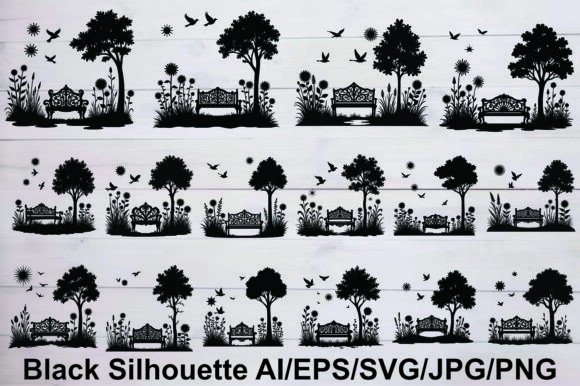
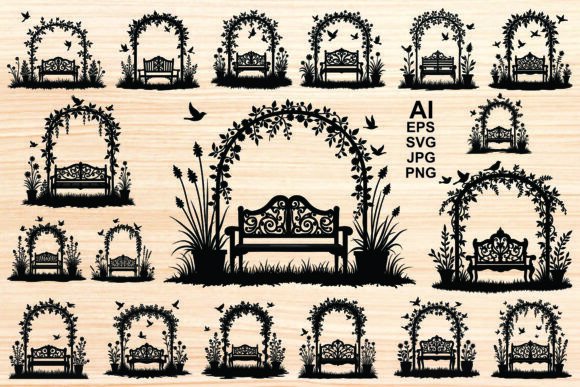
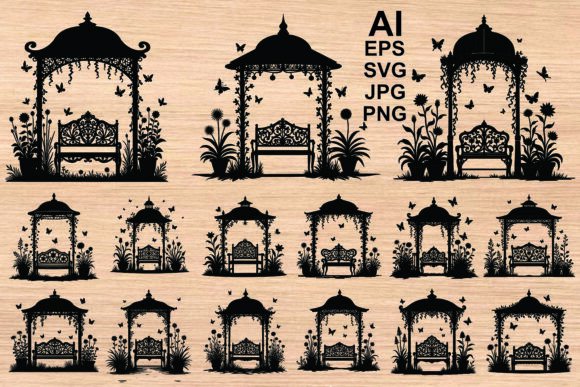
When Silhouette Garden Gazebo Bamboo Black first loaded in my design software, I paused—not because it’s flashy, but because it breathes. It’s a single-layer black silhouette: a delicate arched gazebo with curved benches inside, framed by fluttering butterflies and subtle bamboo-like verticals. No gradients, no drop shadows, no busy filler. Just clean, confident negative space and intentional line weight. That’s rare in garden-themed illustrations—and exactly why it stands out for embroidery.
Where This Design Earns Its Place—Not Just Its Pixels
I recently prepped a batch of linen tea towels for a local boutique’s spring launch. Their customers love botanical motifs—but not the kind that look like clipart stuck on fabric. Silhouette Garden Gazebo Bamboo Black landed perfectly at 4.2" wide, centered above the towel’s hem. Stitched in matte black 40-weight thread on natural linen with medium tear-away stabilizer, it read as hand-drawn, not machine-made. Customers noticed the *stillness* of it—the way the gazebo’s arch echoed the curve of the towel’s fold, how the butterflies didn’t scream “look at me” but invited a second glance. That’s the quiet strength of this design: it elevates handmade product without competing with texture or function.
Real Embroidery Behavior: What Holds Up, What Needs Caution
Silhouette Garden Gazebo Bamboo Black performs best where simplicity meets intention. On sweatshirt embroidery? Excellent—its open shapes avoid dense fill stitch buildup that puckers fleece. As a custom embroidered patch? Strong candidate—clean edges hold up in merrow edging and iron-on backing. For baby embroidery on onesies? Yes—if sized down to 2.5" and stitched with soft, low-density fill (no heavy satin stitch on delicate seams). As a tote bag design? Ideal—it reads clearly at arm’s length and doesn’t overwhelm canvas weight.
But be thoughtful: this isn’t a design for tiny hoops under 3". The bench curves and butterfly wings need breathing room—below 2", detail blurs into blobby stitches. On stretchy fabric like jersey tees? Use cut-away stabilizer *and* baste the design in place first—the open silhouette relies on stable registration. On dark fabric? It shines in black thread, but test contrast with charcoal or navy; true black on black can vanish unless you add a subtle white underlay (check your file for that layer—or plan to digitize one).
Fabric & Fit Notes You’ll Actually Use
- Textured fabrics (burlap, heavy twill, quilted cotton): Embrace them. The silhouette’s bold lines read beautifully over texture—no need to “fight” the surface.
- Thin or sheer fabrics (voile, rayon challis): Add lightweight fusible stabilizer *behind* and a light tear-away *in front* to prevent thread show-through on the reverse.
- Curved surfaces (caps, beanies): Scale down to 3" max and use a cap frame. The symmetrical gazebo shape adapts well—but avoid placing butterflies near the seam ridge where distortion creeps in.
- Frequent-wash items (kitchen towels, baby bibs): Confirm stitch density isn’t overly aggressive. A balanced fill stitch (not ultra-dense) + quality thread = longevity without stiffness.
Why This Design Builds Trust—Not Just Aesthetics
As an Etsy seller and embroidery educator, I watch what makes buyers pause, click, and say *“Yes, that feels like mine.”* Silhouette Garden Gazebo Bamboo Black does that—not through novelty, but through coherence. It signals care: in its spacing, its restraint, its understanding of negative space as part of the design. When stitched on a personalized gift—a linen pillow cover for a gardener friend, a bamboo-cotton baby blanket—it doesn’t shout “handmade!” It *whispers* it. That subtlety builds customer trust faster than any “hand-stitched with love” tagline.
For small shop owners curating cohesive collections, this design slots cleanly into nature-inspired branding—paired with minimalist typography or soft watercolor mockups. It works equally well on digital embroidery file listings (as a clean, recognizable thumbnail) and in printable mockups for social media. No visual competition. Just calm, confident presence.
Practical Designer Checks Before You Stitch
- Test on scrap fabric—same type and color as your final piece. Watch how the gazebo arch holds its shape and whether butterfly wings feather cleanly.
- Review thread colors in natural light. Matte black on oatmeal linen? Warm. On slate gray? Crisp. Avoid glossy poly if aiming for organic feel.
- Check stitch density. If your file includes fill areas (benches, gazebo base), ensure they’re not over-digitized—dense fills distort on textured weaves.
- Confirm hoop size compatibility. At full size, this needs at least a 5"x7" hoop. Don’t force it into a 4"x4" without scaling and rechecking proportions.
- Inspect small details: Are butterfly antennae distinct? Does the bamboo rhythm feel even? If not, a quick vector tweak in Illustrator may help before digitizing.
- Mock it in black and white—no color distraction. Does the silhouette still communicate “gazebo,” “bench,” “butterfly”? If yes, you’ve got clarity.
- Verify licensing. Since this falls under Illustrations and Graphics, confirm whether your use—especially selling finished embroidered goods or reselling digital files—requires extended commercial rights.
The Bottom Line for Makers Who Value Craft Over Clutter
Silhouette Garden Gazebo Bamboo Black isn’t for every project—and that’s its strength. It’s for the maker who chooses meaning over mass, who knows a well-placed butterfly says more than ten floral sprigs, and who understands that in embroidery, silence (negative space) is often the loudest design decision you’ll make. Use it where quiet elegance matters: nursery decor that soothes, boutique merchandise that lingers in memory, personalized gifts that feel seen. Not as filler. As intention.